Comparison · Gel Nails
UV vs LED nail lamps
One of these is not the UV-free option. The difference is how wide the light is and how long you sit under it.
Written by Janet H. · Owner, Janet Media Group
Published
Tip & Topcoat is reader-supported. Product links go through our affiliate resolver and we may earn a commission from qualifying purchases, at no extra cost to you. Prices come from Amazon's API, carry the date they were read, and change constantly — the button always opens the current price on Amazon.
Part of the gel nails hub.
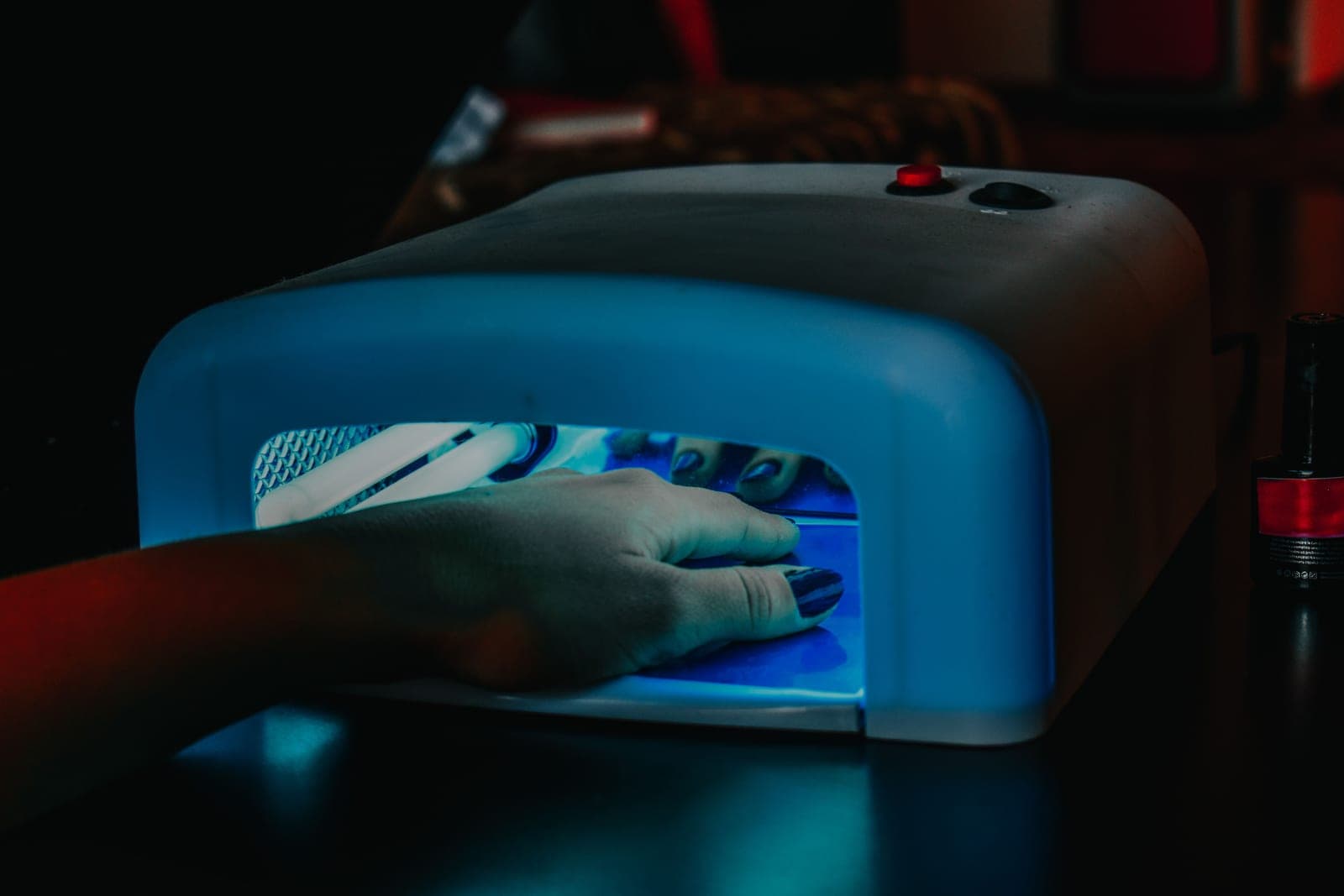
Side by side
| UV (fluorescent tubes) | LED | |
|---|---|---|
| Emits UV | Yes | Yes — all of them |
| Wavelength band | Roughly 320–400 nm | A narrow spike, often ~10 nm wide |
| Cure per coat | 2–3 minutes | 30–60 seconds |
| Bulb life | Tubes dim, then get replaced | No bulb changes expected |
| Curing an unfamiliar gel | More likely to work | Only if the wavelength matches |
| Warm-up | Needs a moment to reach full output | Full output immediately |
| What it costs | Budget, plus tubes forever | Budget to mid, nothing after |
The cure-time figures are SUNUV's own published comparison — two to three minutes per coat for a fluorescent lamp against seconds up to about a minute for LED. They are a lamp manufacturer's numbers, so treat them as a floor rather than a verdict, but the tube lamp in the picks below corroborates them without being asked to: its shortest timer preset is 120 seconds, where the LED lamps offer 10, 30, 60 and 99.
Everything else on that table follows from one physical fact, and it is the fact most shopping advice skips.
LED is not the opposite of UV
The single most common misreading of this category is that LED lamps are the UV-free ones. They are not. All nail lamps emit UV, even those that use LEDs — the UV+EB Technology review of lamp selection puts it in exactly those words. Harvard Health makes the same point from the dermatology side: LED nail lamps emit UV as well, predominantly UVA.
It gets one degree worse before it gets better. The same review notes that LED nail lamps emit greater intensity of UV than fluorescent-style lamps, just in a much narrower range. Per second of exposure, the LED lamp is the stronger one.
What rescues LED on exposure is arithmetic, not marketing: you sit under it for a quarter as long. That is why the AAD's own advice is to choose LED over older UV lamps because they cure faster, reducing exposure — and why the mitigation matters more than the emitter you picked.
The real difference is how wide the light is
Gel does not dry. It cures, because molecules called photoinitiators absorb light at specific wavelengths and start a chain reaction. Those photoinitiators absorb UV-A between 320 nm and 400 nm, but not uniformly across it — each type is energized by only a slice of that window, and the review puts the figure at roughly 10 of the 80 possible wavelengths for a given photoinitiator.
Now compare what the two lamp types put out. NAILS Magazine's technical write-up on gel chemistry describes a fluorescent lamp as emitting a wavelength ranging from roughly 320 to 400 nm, while an LED lamp built around a 375 nm gel will use bulbs that emit from only 370 to 380 nm. One is a floodlight across the whole window. The other is a torch beam pointed at one part of it.
| Lamp | What it emits | Practical consequence |
|---|---|---|
| Fluorescent tube | Wide band, low intensity | Hits more photoinitiators by accident |
| Single-wavelength LED | One narrow spike | Cures what it was matched to, and not much else |
| Dual-wavelength LED | Two spikes, e.g. 365 + 405 nm | Covers both common curing windows |
This is the whole reason dual-wavelength LED lamps exist, and the one specification worth paying for. Older UV formulas cluster around 365 nm and most LED-curable gels around 405 nm; a lamp that emits at both does not care which bottle you bought. Both lamps in our lamp roundup are dual-wavelength for that reason — and if a salon has quoted you shellac as a separate product, gel nails vs shellac explains why it is not — and wattage — the number printed largest on the box — tells you nothing about any of it.
Getting it wrong is not a cosmetic failure. The same review describes gel that appears cured while only 50% cured, and warns that uncured monomers left in dust and filings cause adverse skin reactions, such as skin irritation or allergy on repeated exposure. The everyday version of the same problem is a manicure that lifts in a sheet on day three — diagnosed in why gel polish peels.
Cure time is the difference you actually feel
A gel manicure is four cures, not one: base coat, two color coats, top coat. That multiplier is where the two technologies separate in a way you notice on a Tuesday evening.
| Step | LED at 30–60s | Tube lamp at 120s |
|---|---|---|
| Base coat | 30–60s | 120s |
| Color, two coats | 60–120s | 240s |
| Top coat | 30–60s | 120s |
| Total curing, one hand | 2–4 min | 8 min |
| Both hands, if cured separately | 4–8 min | 16 min |
Eight minutes of holding a hand flat inside a box is not a rounding error, and it is eight minutes during which you cannot scroll, cook or pick anything up. It is also, per the AAD note above, four times the UV exposure for the same manicure.
The counter-argument is thin but real: a longer, gentler cure spreads the gel's own heat release over more time. That heat is the exothermic curing reaction rather than the lamp, which is why thin coats fix the burning sensation better than any lamp choice does. Neither technology is cool and neither is the cause.
Tubes dim. That is the sneakiest cost here
Fluorescent tubes lose output as they age. SUNUV states the position plainly for its own category — tubes dim with use and need replacing, against no bulb changes and a multi-year estimated lifespan for an LED array.
The money is trivial. MelodySusie sells a 9W 365 nm replacement tube for its S-Pro04 lamp for single-figure dollars. The problem is that a dimming tube does not announce itself. It still lights up, the timer still beeps, and the gel is quietly getting less energy than the manufacturer's cure time assumes. You find out weeks later, from a manicure that peels for no reason you can trace.
Honesty cuts the other way too, and most comparisons leave this out: a tube is replaceable and an LED array is not. LEDs degrade far more slowly, but when a bead array fails or the driver dies, the lamp is landfill. The tube lamp is the only one of the three picks below that can be repaired with a part you can buy.
Are all UV nail lamps the same?
No, and the industry position on this is blunter than the shopping advice. NAILS Magazine: there is no universal gel light that will cure all gels — UV and LED and from any manufacturer. The UV+EB review adds the mechanism: some LED nail lamps cannot properly cure formulations that contain photoinitiators requiring a different range of wavelengths than these lamps emit, and says a well-designed product system should tell you which lamp to use.
So the buying rule is short:
- Your gel names a lamp. Buy that lamp, or a dual-wavelength LED that covers the wavelength it specifies. Professional lines are the strictest about this — see what each gel brand commits you to. If the dip comparison you actually want is against soft gel tips rather than gel polish, that is Gel-X vs dip powder.
- Your gel names nothing. Dual-wavelength LED. It is the specification that makes the question stop mattering.
- You own gels from several brands. Same answer, more urgently. A single-spike lamp is how one bottle in your drawer silently stops working.
- You cure hard gel, builder gel, polygel or resin. Check the cure time your product publishes, not the lamp's shortest preset. Thick product is where a 99-second setting earns its place, and where a wide-band tube lamp still has a job.
The same logic applies to extension systems, which cure thicker product than polish does — soft gel tip kits list their lamp requirement for exactly this reason.
The wattage question specifically — whether 48W beats 36W, and what the number on the box is even measuring — is answered in how many watts a UV nail lamp needs.
Do nail lamps work on regular polish?
No — and this one is worth being clear about, because people buy a lamp hoping it will. Regular polish hardens by solvent evaporation. It contains no photoinitiators, so there is nothing in it for either lamp to act on. NailKnowledge puts it directly: traditional nail polish simply doesn't have the chemical components necessary to benefit from UV/LED exposure.
What actually happens is worse than nothing. A lamp that emits any warmth would only speed up the solvents evaporating at the surface, which skins the top layer while the polish underneath stays soft — so it smudges and dents hours later rather than setting properly. You have interrupted air-drying, not replaced it.
Which lamp for which reader
Picks
The lamps on either side of this
Two dual-wavelength LED lamps and the fluorescent-tube lamp the UV column describes. All three were in stock on their own brand's store when this page was written.
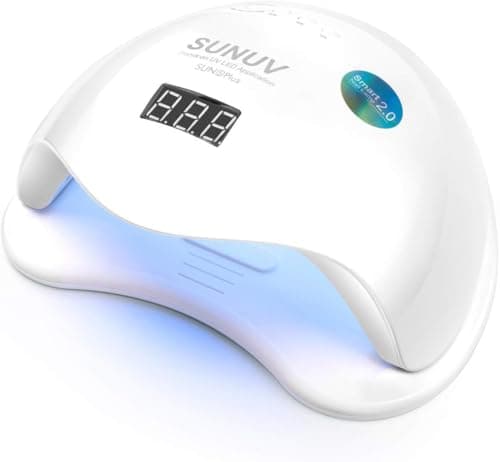
Wide hands, long nails, or curing all five fingers at once
SUNUV SUN5 Plus
The same 48W and the same timers as the SUN5, with half again as many LEDs spreading the cure more evenly.
- Power
- 48W, 36 dual-spectrum LEDs
- Timers
- 10s / 30s / 60s / 99s
Skip ifSkip this if you find gel curing uncomfortably hot. A denser LED array is warmer on the fingertips, not cooler.
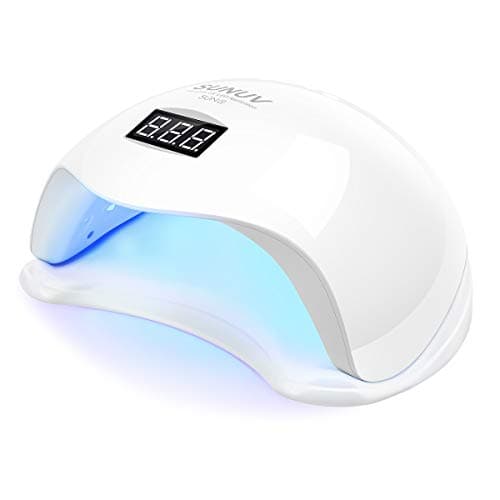
One lamp that will cure whatever gel you buy
SUNUV SUN5
Dual 365 nm and 405 nm output, four timers and a removable base — the specification most home users actually need.
- Power
- 48W, 24 dual-spectrum LEDs
- Timers
- 10s / 30s / 60s / 99s
Skip ifSkip this if you have wide hands or long nails. The larger lamp lights the corners more evenly.
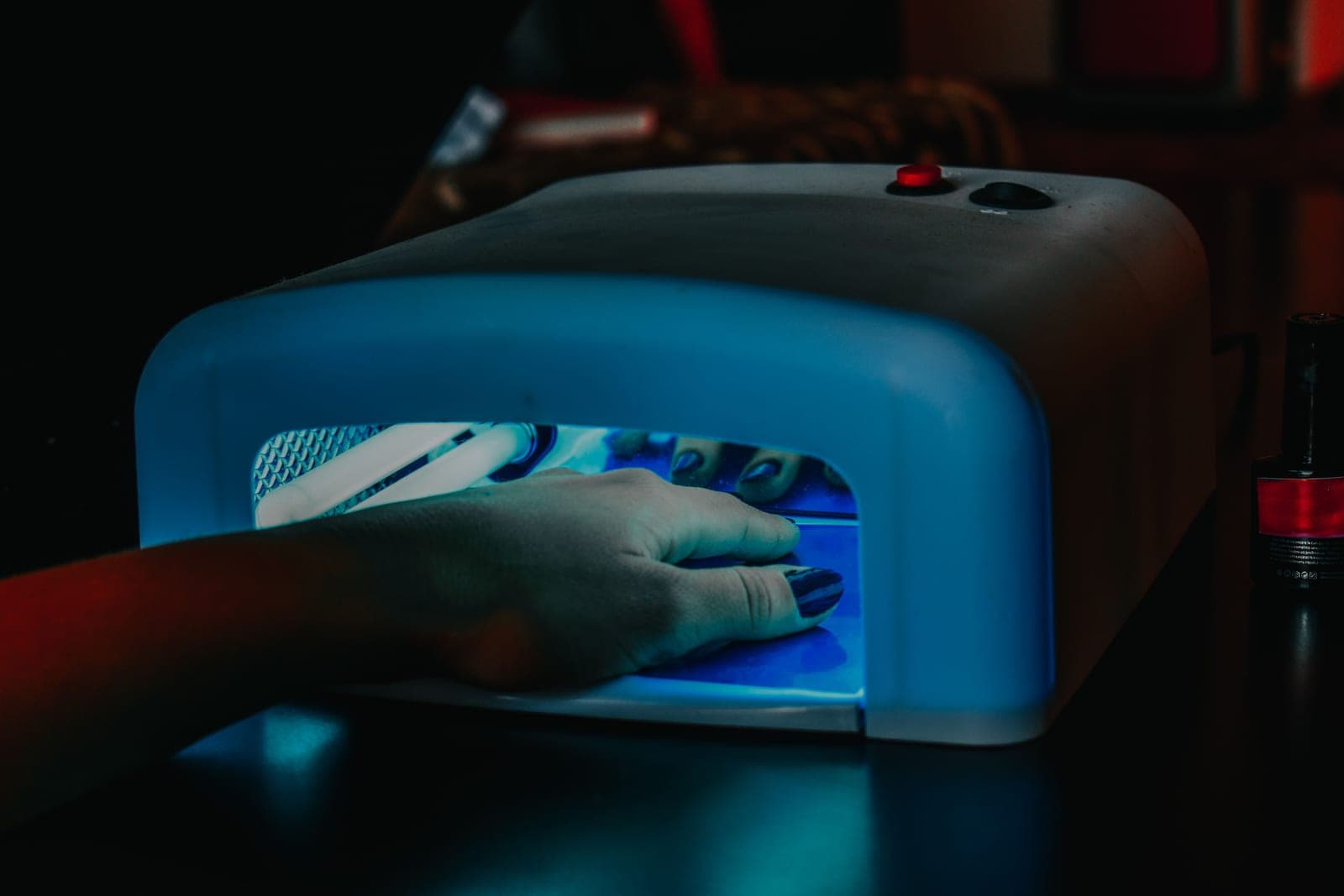
Gels and resins an LED lamp will not cure, and anyone who wants replaceable tubes
MelodySusie SOL 1 (S-Pro04) UV Nail Lamp
A real fluorescent-tube UV lamp: four replaceable 365 nm tubes, cure times in minutes rather than seconds.
- Power
- 36W, four 9W tubes
- Wavelength
- 365 nm
Skip ifSkip this if your gel brand specifies an LED lamp, or if you will not sit through two minutes per coat. For most people at home that is both.
FAQ
Frequently asked questions
Is an LED nail lamp better than a UV one?
For almost everyone at home, yes — it cures in 30 to 60 seconds against 2 to 3 minutes, needs no bulb changes, and that shorter cure is why the AAD recommends LED over older UV lamps. The exception is a gel whose photoinitiator falls outside the LED's narrow band.
Do LED nail lamps emit UV?
Yes, all of them. UV+EB Technology states that all nail lamps emit UV, even those using LEDs, and that LEDs emit a greater intensity of it in a narrower range. "LED" describes the emitter, not the absence of UV.
Can I use any gel in any lamp?
No. NAILS Magazine states there is no universal gel light that cures all gels from any manufacturer. Match the lamp to the wavelength your gel specifies, or buy a dual-wavelength lamp that covers both common windows.
How often do UV nail lamp bulbs need replacing?
Fluorescent tubes dim with use rather than failing outright, so the lamp under-cures before it stops working. Replace them as a set when cures start needing longer than the published time. MelodySusie sells 9 W 365 nm tubes for its S-Pro04 for a few dollars.
Can a UV or LED lamp dry regular nail polish?
No. Regular polish hardens by solvent evaporation and contains no photoinitiators. The lamp's warmth skins the surface and leaves the layers underneath soft, which makes smudging more likely rather than less.
What wavelength nail lamp should I buy?
One that emits at both 365 nm and 405 nm. Older UV formulas cluster near 365 nm and most LED-curable gels near 405 nm, so a dual-wavelength lamp removes the compatibility question entirely. Wattage is not the specification that decides it.
Keep reading
Related guides
- The best UV and LED nail lamps →
Once you have picked a technology.
- Are UV nail lamps safe? →
The evidence, with its limits.
- Gel look without a lamp →
If the answer is neither.
- Gel polish brands, compared →
Which brands name a lamp.
- Why gel polish peels →
Usually an under-cure.
- The best gel kits →
Lamp and gel matched in one box.
Sources
- —UV+EB Technology — The importance of using the correct nail lamp to ensure proper curing of UV nail products (2023) · uvebtech.com
- —NAILS Magazine — The science of gels: how gel nail products work · nailsmag.com
- —NailKnowledge — Can I cure nail polish in a lamp? · nailknowledge.org
- —Harvard Health — Safety of LED nail lamps · health.harvard.edu
- —AAD — Artificial nails: reducing nail damage · aad.org
- —SUNUV — UV vs LED nail lamp (manufacturer comparison) · sunuv.com
- —SUNUV — SUN5 Plus · sunuv.com
- —SUNUV — SUN5 · sunuv.com
- —MelodySusie — SOL 1 (S-Pro04) UV Nail Lamp · melodysusie.com