Guide · Guides
How many watts does a UV nail lamp need?
48W is the number everyone shops on, and it is the wrong number. Wavelength is what cures gel; watts only tell you how fast.
Written by Janet H. · Owner, Janet Media Group
Published
Tip & Topcoat is reader-supported. Product links go through our affiliate resolver and we may earn a commission from qualifying purchases, at no extra cost to you. Prices come from Amazon's API, carry the date they were read, and change constantly — the button always opens the current price on Amazon.
Part of the guides hub.
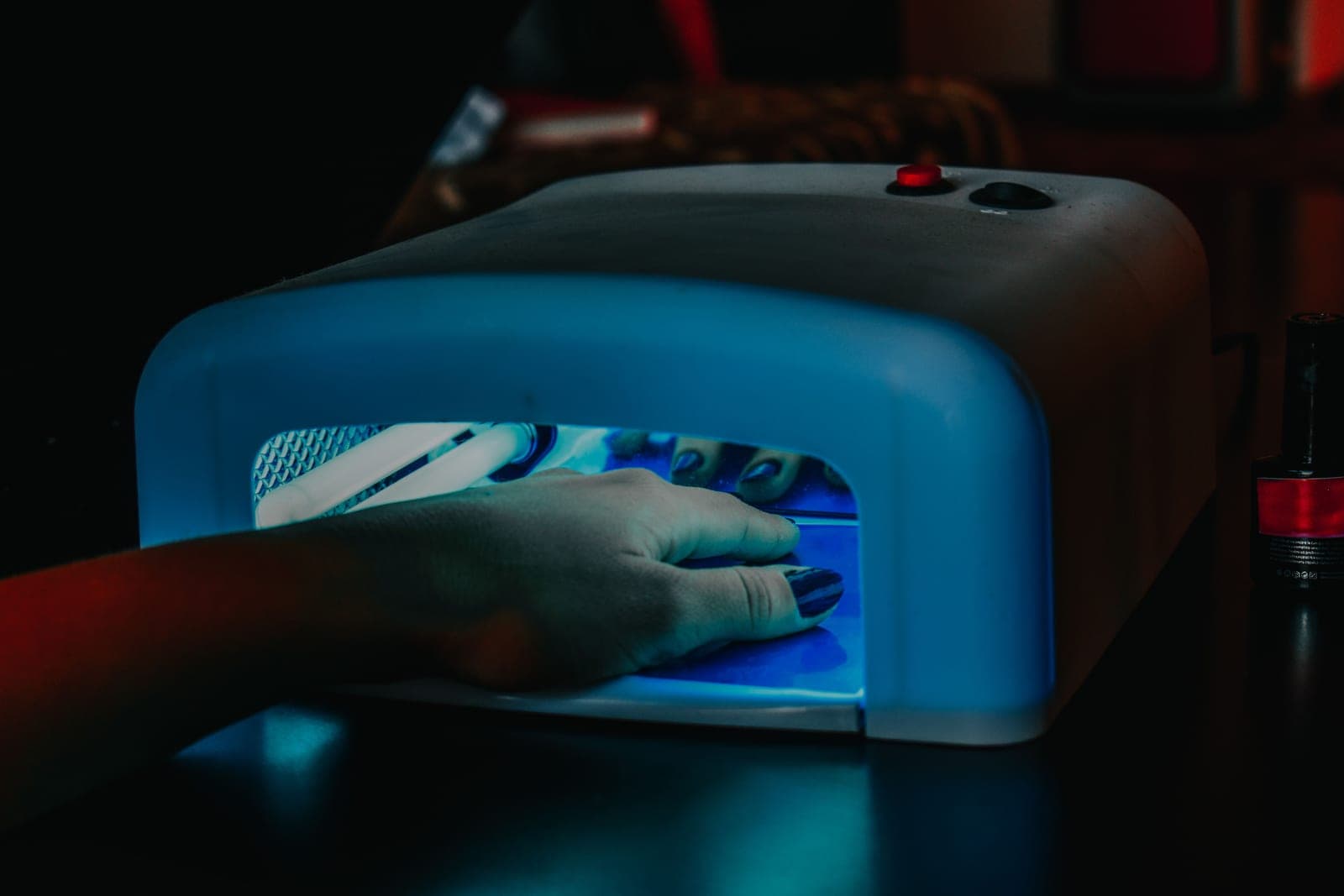
Watts tell you speed. Wavelength tells you whether it works at all
Gel cures because a photo-initiator in the formula absorbs light at a specific wavelength and starts a chain reaction that links the monomers into a solid. The initiator is tuned to a band, and light outside that band does essentially nothing.
So the question is not how much light the lamp puts out. It is whether the light is the right color. The industry guidance on matching lamp to product is blunt about this: using a lamp whose output does not match the product's initiator is the standard cause of an under-cure, and an under-cured gel is both a failed manicure and a skin-irritation risk.
Wattage, once you are in a sensible range, only changes how long you sit there. A 48W lamp curing a coat in 30 seconds and a 24W lamp curing the same coat in 60 seconds produce the same cured film. What a very low-wattage lamp does do — and this is the real failure — is not reach full cure at all in the time the timer allows, which leaves soft gel under a hard surface.
What the numbers on the box actually mean
| Spec | What it tells you | What to look for |
|---|---|---|
| Wattage | Total power draw, loosely related to cure speed | 36-48W for home use |
| Wavelength | Whether your gel will cure | 365 nm + 405 nm dual band |
| LED count and layout | Whether all five nails get even light | LEDs on the sides and roof, not just the roof |
| Timers | Flash cure vs full cure control | At least 30 s and 60 s; 10 s flash is useful |
| Opening width | Whether your hand fits flat | Matters for wide hands and long nails |
| Removable base | Whether you can cure a foot | Useful if you do pedicures |
Two real examples from this registry. SUNUV publishes 48W across 24 dual-spectrum LEDs at 365 nm and 405 nm, with 10, 30, 60 and 99 second timers for the SUN5 — that is the full spec worth asking for, and it is why it is the default recommendation on the lamp roundup. The SUN5 Plus is the wider version of the same idea, which matters more than extra watts if your hands are wide or your nails are long.
MelodySusie's SOL 1 is the other shape of answer: 36W from four 9W UV tubes at 365 nm. Lower wattage, single band, and genuinely useful — because some gels and resins are formulated for 365 nm and will not cure under a 405 nm-only LED. It also has replaceable tubes, which an LED unit does not.
So how many watts do you actually need?
For gel polish, builder gel and semi-cured strips at home: 36W to 48W, dual wavelength. That covers everything in normal use and nothing above it buys you a better manicure.
Below about 24W you start to see real problems — mini lamps bundled with cheap starter kits are frequently in this territory, and they are the reason a lot of people conclude gel "does not work" for them. A mini lamp cures one or two fingers at a time and often lacks the published wavelength spec entirely.
Above 48W, the marketing numbers get creative. A "168W" lamp is quoting the sum of its LED ratings rather than anything it draws or emits, and it cures no better than a well-specified 48W unit. Treat a very large wattage claim with no wavelength figure as a reason to look elsewhere.
UV tubes or LED?
Both are UV. This is the single most misunderstood point in the category: an LED nail lamp emits ultraviolet light, it just emits a narrower band of it than a fluorescent tube does. There is no such thing as a UV-free nail lamp that cures gel.
The practical differences are speed, bulb life and coverage. LED cures faster and the diodes effectively never need replacing; UV tubes dim with use and need swapping, which is a running cost people forget. The full comparison, including why "LED is safer" is not the claim people think it is, is in UV vs LED nail lamps, and the safety evidence itself is in are UV nail lamps safe.
One thing neither will do is dry regular nail polish. Lacquer has no photo-initiator, so there is nothing in it for the lamp to cure — the practical version of that is in how long nail polish takes to dry.
If your gel is not curing, check these first
- Is the coat too thick? Light cannot reach the bottom of a thick layer. This is the most common cause by a distance and it has nothing to do with the lamp.
- Is the thumb getting the same light? Most lamps cure four fingers well and the thumb badly. Cure thumbs separately.
- Does the lamp publish a wavelength? If not, and your gel is failing, that is the likely answer.
- Are the tubes old? UV tubes dim gradually, so a lamp that worked a year ago can under-cure now at the same timer setting.
- Is the inside of the lamp dirty? Cured gel splatter on the reflective interior reduces output over time. Wipe it.
The full diagnostic, in order of likelihood, is in why your gel polish is not curing.
Picks
Three lamps that publish the spec that matters
A 48W dual-wavelength LED, its wider sibling for long nails and big hands, and a 36W UV tube lamp for the gels an LED will not cure.
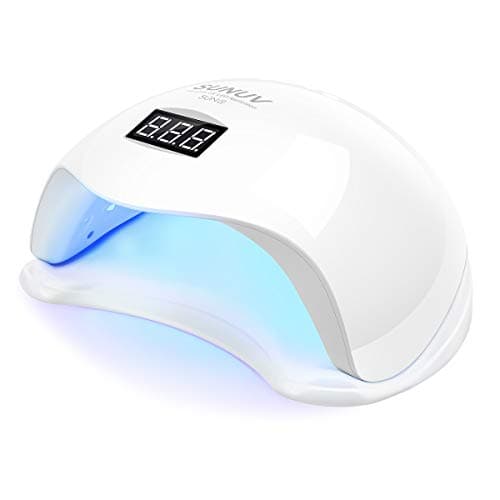
One lamp that will cure whatever gel you buy
SUNUV SUN5
Dual 365 nm and 405 nm output, four timers and a removable base — the specification most home users actually need.
- Power
- 48W, 24 dual-spectrum LEDs
- Timers
- 10s / 30s / 60s / 99s
Skip ifSkip this if you have wide hands or long nails. The larger lamp lights the corners more evenly.
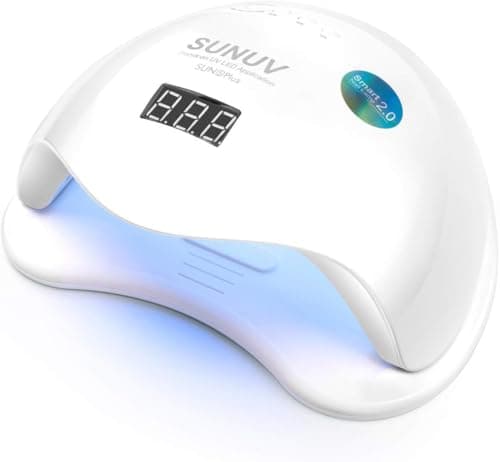
Wide hands, long nails, or curing all five fingers at once
SUNUV SUN5 Plus
The same 48W and the same timers as the SUN5, with half again as many LEDs spreading the cure more evenly.
- Power
- 48W, 36 dual-spectrum LEDs
- Timers
- 10s / 30s / 60s / 99s
Skip ifSkip this if you find gel curing uncomfortably hot. A denser LED array is warmer on the fingertips, not cooler.
Gels and resins an LED lamp will not cure, and anyone who wants replaceable tubes
MelodySusie SOL 1 (S-Pro04) UV Nail Lamp
A real fluorescent-tube UV lamp: four replaceable 365 nm tubes, cure times in minutes rather than seconds.
- Power
- 36W, four 9W tubes
- Wavelength
- 365 nm
Skip ifSkip this if your gel brand specifies an LED lamp, or if you will not sit through two minutes per coat. For most people at home that is both.
FAQ
Frequently asked questions
How many watts should a UV nail lamp be?
36W to 48W is the useful range for home use. Wattage mainly affects how long a cure takes, not whether it works — the specification that decides that is wavelength. A dual-wavelength lamp emitting both 365 nm and 405 nm will cure nearly every gel on the market.
Is a 48W nail lamp better than a 36W?
Slightly faster, not better. Both will fully cure gel polish if the wavelength matches the product. A 36W UV tube lamp at 365 nm will cure some gels that a 405 nm-only LED cannot, which matters more than the twelve watts.
Is a higher wattage nail lamp safer or more dangerous?
Higher wattage means more output, so exposure per second is higher — but cure times are correspondingly shorter, so total exposure per manicure is broadly similar. The evidence on nail lamp exposure generally is covered in our guide to whether UV nail lamps are safe.
Will a cheap mini nail lamp cure gel polish?
Often not properly. Mini lamps bundled with budget kits are frequently under 24W, cure one or two fingers at a time, and rarely publish a wavelength. An under-cured gel stays soft underneath, fails early, and increases the chance of skin irritation.
Can a UV nail lamp dry regular nail polish?
No. Regular polish dries by solvent evaporation and contains no photo-initiator, so there is nothing for the lamp to cure. Any marginal effect comes from the lamp's warmth and airflow, not its light.
Keep reading
Related guides
- Best UV and LED lamps →
The lamps, ranked.
- UV vs LED lamps →
Why neither is UV-free.
- Gel not curing →
The full diagnostic.
- Are UV nail lamps safe? →
What the evidence says.
Sources
- —SUNUV — SUN5 published specification · sunuv.com
- —SUNUV — SUN5 Plus · sunuv.com
- —MelodySusie — SOL 1 (S-Pro04) UV nail lamp · melodysusie.com
- —MelodySusie — 9W replacement UV tube · melodysusie.com
- —UV+EB Technology — using the correct nail lamp · uvebtech.com
- —NailKnowledge — can I cure nail polish in a lamp? · nailknowledge.org