Guide · Guides
Gel polish and sensitive skin
Itching around the cuticle after a gel manicure has a mechanism, and in most cases it has a fix that is not a different bottle.
Written by Janet H. · Owner, Janet Media Group
Published
Tip & Topcoat is reader-supported. Product links go through our affiliate resolver and we may earn a commission from qualifying purchases, at no extra cost to you. Prices come from Amazon's API, carry the date they were read, and change constantly — the button always opens the current price on Amazon.
Part of the guides hub.
Why gel irritates skin at all
Cured gel is close to inert. Uncured gel is not. That one sentence explains most of what happens in this category, and it reframes the problem usefully: the question is rarely which brand you bought, it is whether liquid monomer reached your skin.
Gel polish is a mix of methacrylate monomers and a photo-initiator. Under the right wavelength of light the monomers link into a solid polymer, and that reaction is what curing is. A fully cured film has very little free monomer left in it. An under-cured film has plenty, sitting against your nail and your cuticle for the next two weeks.
So there are exactly two routes for monomer to reach skin:
- Application contact. Gel flooded onto the cuticle or sidewall, or wiped onto skin with a brush, and then cured there. The cured ridge on skin is uncomfortable; the liquid that sat there before curing is the sensitizer.
- Under-curing. A coat too thick, a lamp with the wrong wavelength, a timer cut short, or a thumb sitting outside the light. The surface sets, the underside does not, and the set holds liquid monomer against the nail bed for as long as you wear it.
Both are application problems, and both are fixable without changing products — which is why the advice in this guide starts there rather than with a shopping list.
Sensitive skin, or an actual allergy
These need separating, because the response is different and one of them is not a shopping decision at all.
Irritation is immediate and local. Stinging as the gel goes on or during the cure, redness exactly where product touched, gone within a few hours. Dryness from acetone removal belongs in this group too, and it is the most common complaint in the whole category.
Allergic contact dermatitis is delayed and spreading. It appears 12 to 72 hours after the manicure, it extends past the exact contact area, it itches rather than stings, and it comes back worse on the next exposure. It can also show up somewhere else entirely — eyelids and face are common, because you touch them and that skin is thinner. The AAD's guidance on gel manicures names allergic reaction as a recognized risk of this chemistry.
What HEMA-free actually means
HEMA is hydroxyethyl methacrylate, a small monomer used widely in gel products because it improves adhesion and flow. It is also the single most frequently reported allergen in nail products, and its small molecular size is part of why: it penetrates skin more readily than larger monomers do.
A HEMA-free formula removes that specific molecule. That is a genuine reduction in risk and it is the right choice if you have reacted before. Three honest caveats:
- HEMA-free is not monomer-free. The formula still contains other acrylates and methacrylates, any of which can sensitize. Removing the most common allergen is not removing the category.
- HEMA-free gels handle differently. They are generally thicker and slower to level, which means working in smaller beads and resisting the urge to apply thicker to compensate. Applying thicker undoes the benefit by making under-curing more likely.
- The label is not regulated as a safety claim. Read the brand's own statement rather than a marketplace listing's keywords.
| Product | Formula claim | Source of the claim |
|---|---|---|
| Beetles Builder Gel, Jelly Pink | HEMA-free, 8-in-1 | Brand product page |
| Olive & June Gel Mani System | Brand states the gels are HEMA-free | Brand product page |
| Aprés Gel-X Signature Kit | Extend Gel and top coat stated HEMA- and TPO-free | Brand product page |
Those three are the HEMA-free options in this registry, and the list is short because most brands do not make the claim. A brand that is silent on it has probably not reformulated.
The application changes that do most of the work
If you have sensitive skin rather than a diagnosed allergy, these five changes remove most of the exposure, and they cost nothing.
- Leave a hairline margin at the cuticle. A gap you can barely see is enough. Floating the color up to the skin is the single biggest source of contact, and the margin is invisible once the nail grows a day.
- Cap the free edge with the brush, not your fingertip. Sealing the tip is correct technique; doing it with your other hand puts gel on that skin instead.
- Thin coats, every time. Two thin coats cure completely; one thick coat does not. This is the same rule as everywhere else in gel, and here it is a skin issue rather than a durability one.
- Cure for the full published time, in a lamp that matches. A dual-wavelength lamp covers the curing window of products from different brands; a lamp and product mismatch is the usual cause of under-curing. Cure the thumb separately — laid flat with the other fingers it sits outside the light.
- Wipe the inhibition layer with alcohol, not with your finger. The tacky layer on a non-no-wipe top coat is uncured by design. Remove it with a lint-free wipe.
The removal side matters too: acetone dries both plate and skin, and a dry, cracked nail fold is more permeable to anything you put near it. Fingertip-only soaks, per the AAD's method, and oil daily afterwards.
If gel is not going to work for you
For some people the honest answer is to leave the chemistry alone, and there are good routes to a long-wearing manicure that involve no acrylates and no lamp.
Long-wear lacquer systems are the closest substitute. essie publishes up to 15 days for Gel Couture with a day-7 top coat reapplication, and OPI publishes up to 11 days for Infinite Shine — both without a cure step and both removable with ordinary polish remover. The picks are in gel polish without a UV light and longest-lasting nail polish.
If the appeal of gel was strength rather than wear, a strengthener and a good base coat get you most of the way with none of the exposure — the best manicure for weak nails ranks every option on that basis. And if you want length with the least chemistry touching skin, adhesive tabs and a press-on set involve no monomer at all; the options are in press-ons that won't damage nails.
Picks
HEMA-free options in this registry
The HEMA-free builder gel, the kit whose maker states its gels are HEMA-free, and a dual-wavelength lamp — because under-curing is a bigger driver of skin reactions than the formula is. None of this replaces seeing a doctor about a reaction.
Sensitive skin, and hiding a regrowth line
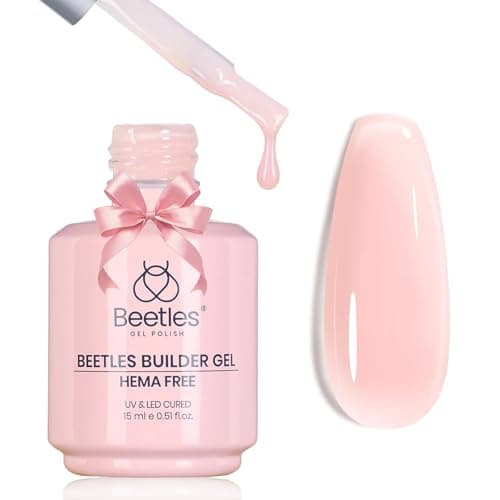
Beetles Builder Gel, Jelly Pink (HEMA-Free)
A HEMA-free tinted builder — the version to buy if gel has ever made your skin itch or your nails sting under the lamp.
- Bottle
- 15 mL
- Formula
- HEMA-free, sold as 8-in-1
Skip ifSkip this if you want a clear finish. Jelly pink is pink, and it reads as pink over a pale nail.
A first gel manicure you want to get right on the first attempt
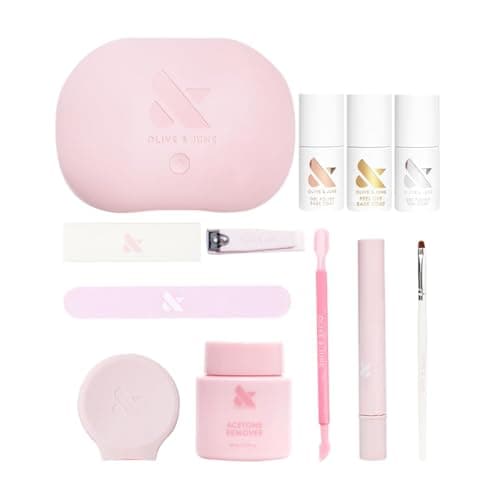
Olive & June Gel Mani System
The most complete box here, and the only one that ships a peel-off base coat so removal does not have to mean acetone.
- Cure time
- 2 minutes per coat
- Brand wear claim
- Up to 21 days
Skip ifSkip this if you are impatient. Four coats at two minutes each is eight minutes of sitting still per hand.
One lamp that will cure whatever gel you buy
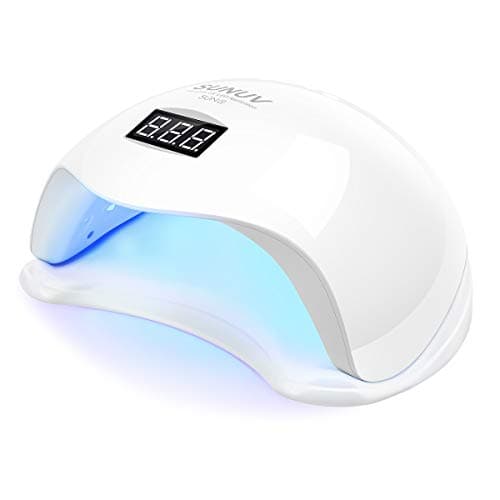
SUNUV SUN5
Dual 365 nm and 405 nm output, four timers and a removable base — the specification most home users actually need.
- Power
- 48W, 24 dual-spectrum LEDs
- Timers
- 10s / 30s / 60s / 99s
Skip ifSkip this if you have wide hands or long nails. The larger lamp lights the corners more evenly.
FAQ
Frequently asked questions
What is the best gel polish for sensitive skin?
A HEMA-free formula applied without touching skin and cured fully. In this registry the HEMA-free options are Beetles' HEMA-free builder gel and the Olive & June gel system, whose maker states its gels are HEMA-free. Technique matters more than the bottle: uncured monomer is the sensitizer, not cured gel.
Why does gel polish make my cuticles itch?
Because uncured gel reached the skin — either it flooded the cuticle during application, or the coat did not fully cure and is holding liquid monomer against the nail fold. Leave a hairline margin at the cuticle, apply thinner coats, and cure for the full published time.
Is HEMA-free gel polish hypoallergenic?
No. HEMA is the most commonly reported allergen in nail products, so removing it lowers the risk meaningfully, but other acrylates in the same formula can still sensitize. HEMA-free is a sensible choice rather than a guarantee.
Can gel polish cause an allergy?
Yes — allergic contact dermatitis to acrylates is a recognized risk, and the AAD names it in its guidance on gel manicures. It typically appears 12 to 72 hours after a manicure, spreads past the contact area, and worsens with each exposure. That pattern needs a dermatologist, not a different brand.
Does an LED lamp help with sensitivity?
Indirectly, and significantly. A lamp whose wavelengths match your product cures the gel completely, and complete curing is what leaves no free monomer behind. A dual-wavelength lamp with a long timer is the useful specification.
Keep reading
Related guides
- Nail glue allergy →
If glue was the trigger.
- Are UV nail lamps safe? →
The other gel safety question.
- Gel look without a lamp →
No cure step at all.
- Gel polish not curing →
Fix the under-cure.
Sources
- —AAD — Gel manicures: dermatologists share tips · aad.org
- —NAILS Magazine — The science of gels · nailsmag.com
- —UV+EB Technology — Using the correct nail lamp · uvebtech.com
- —AAD — Removing gel polish · aad.org
- —Beetles — Builder Gel for Nails, HEMA-Free Jelly Pink · beetlesgel.com
- —Olive & June — Gel Mani System · oliveandjune.com
- —SUNUV — SUN5 · sunuv.com