Guide · Guides
Nail glue allergy: what it looks like and what to use instead
Itching and redness around the cuticle after a set is not normal, and it is not something to push through.
Written by Janet H. · Owner, Janet Media Group
Published
Tip & Topcoat is reader-supported. Product links go through our affiliate resolver and we may earn a commission from qualifying purchases, at no extra cost to you. Prices come from Amazon's API, carry the date they were read, and change constantly — the button always opens the current price on Amazon.
Part of the guides hub.

What a reaction looks like
The pattern that distinguishes an allergic reaction from ordinary irritation is the timing and the location. Irritation is immediate, confined to where the glue touched, and fades within hours. An allergic contact reaction appears 12 to 72 hours after exposure, spreads beyond the exact contact point, and gets worse rather than better over the following days.
The signs people describe most often:
- Itching around the cuticle and sidewalls — usually the first symptom, and the one most easily dismissed as dryness.
- Redness and swelling of the skin at the nail fold, sometimes with small fluid blisters.
- Dry, cracked, scaly skin on the fingertips that persists after the nails come off.
- Reactions somewhere other than your hands — eyelids, face, neck. This sounds strange and is common: you touch your face, and the skin there is thinner and reacts more readily than the skin on your fingers.
- The nail plate lifting from the bed, or nail thinning and ridging, in a longer or more severe reaction.
What you are actually reacting to
Nail glue is cyanoacrylate. Gel products are acrylates and methacrylates — most commonly HEMA, which is the single most-reported allergen in the nail category. They are chemically related, and a sensitivity to one often means a sensitivity to the family, which is why people who react to glue frequently react to gel as well.
The mechanism matters for one practical reason: sensitization is cumulative and irreversible. The first few exposures may produce nothing. Once your immune system has learned the molecule, it reacts every time, and the reaction tends to get stronger rather than fading with familiarity. There is no building up a tolerance here, and pushing through a mild reaction is how a mild reaction becomes a severe one.
Two further points that are widely misunderstood:
- Cured product is far less reactive than uncured product. A fully cured gel or a fully set glue bond has very little free monomer left. Almost all reactions trace to liquid adhesive touching skin, or to gel that did not cure properly.
- "HEMA-free" is not "hypoallergenic". Removing the most common allergen reduces the odds considerably. It does not remove them, because the other monomers in the formula can sensitize too.
Irritation, allergy or just dryness
Three different things produce sore skin around the nail after a set, and they need three different responses. This is the table worth reading before you throw out a glue bottle.
| Sign | Dryness | Irritation | Allergic reaction |
|---|---|---|---|
| Timing | Builds over days of acetone use | Immediately on contact | 12-72 hours after |
| Where | Whole fingertip, both hands | Exactly where product touched | Spreads past the contact point |
| Itching | Mild or none | Stinging more than itching | Pronounced, often the first sign |
| Blisters | No | Rarely | Sometimes |
| Course | Improves with oil in days | Gone within hours | Worsens, and recurs on every exposure |
| What to do | Oil daily, space your sets out | Keep adhesive off skin | Stop, and see a doctor |
Most sore fingertips in this category are the first column. Repeated acetone soaks strip the plate and the surrounding skin, and the result looks alarming without being an allergy at all. If oil and a week off fix it, it was dryness. If it comes back on the next set, in the same place, two days after application, treat it as the third column.
What to switch to
The useful move is not a different brand of glue — the allergen is the chemistry, not the label. It is a different kind of adhesive, or a different kind of nail.
If none of these work for you, the answer may be no artificial nails at all, and that is a legitimate outcome rather than a failure. A strengthener and a polish routine gets a good-looking nail with no acrylate chemistry involved — the options are in nail strengtheners and the best manicure for weak nails.
Reducing exposure if you keep using glue
If your reaction is mild irritation rather than a diagnosed allergy, and you and your doctor are comfortable continuing, the goal is simple: no liquid adhesive on skin, ever.
- Use a nozzle tip, not a brush. A controlled line down the center of the nail bed, pressed outward by the nail itself, keeps glue inside the perimeter. A wide brush puts it on the cuticle.
- Glue the nail, not the finger. Putting the bead inside the press-on and pressing down means the squeeze-out goes under the tip rather than onto skin.
- Wipe any squeeze-out immediately, before it sets, with a lint-free wipe.
- Do not file over a glue bead on skin. Filing turns cured adhesive into dust you then breathe and spread.
- Keep the sets spaced out. Fewer exposures is fewer chances to sensitize further.
And do not file the natural nail to improve grip. The AAD guidance on artificial nails is clear that it thins the plate, and a thinned plate is both more fragile and more permeable to whatever you put on it.
Recovering the skin and nail afterwards
Once the trigger is gone, the skin recovers in one to three weeks. The nail takes longer, because it only improves as it grows: fingernails grow at roughly three and a half millimeters a month, so a plate that has thinned or ridged takes three to six months to replace itself entirely.
In the meantime, the useful things are unglamorous. Cuticle oil daily, on the nail fold as well as the plate. Gloves for wet work and cleaning. No enhancements while the skin is still reacting, and no buffing the ridges out — that removes plate you need. The full recovery routine is in repairing damaged nails, and the habits that keep a recovered nail in good shape are in nail care basics.
Picks
Adhesives and systems that avoid liquid glue
Tabs that involve no cyanoacrylate at all, a set whose adhesive is pre-applied and never touches skin, and a HEMA-free builder gel if your reaction was to gel rather than glue. None of these is a substitute for seeing a doctor about a reaction.
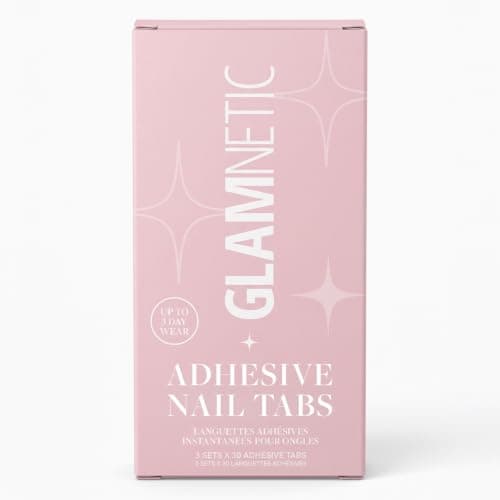
A set you want off again in a few days
Glamnetic Adhesive Nail Tabs
Tabs with a published wear figure, which is the honest way to sell a short-wear adhesive.
- Brand wear claim
- Up to 5 days
- Type
- Pre-cut adhesive tabs
Skip ifSkip this if your nails are strongly curved. A flat tab cannot bridge a curve, and the set will lift at the edges.
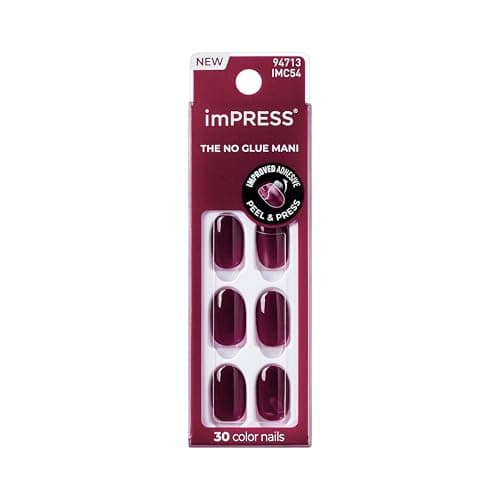
Getting a manicure on in ten minutes with nothing to dry
KISS imPRESS Press-On Manicure
No glue at all: the adhesive is pre-applied, you peel a tab and press. The fastest set here by a distance.
- Nails per set
- 30
- Brand wear claim
- Up to 10 days
Skip ifSkip this if you need a full two weeks out of one set. The adhesive is built for convenience, not maximum duration.
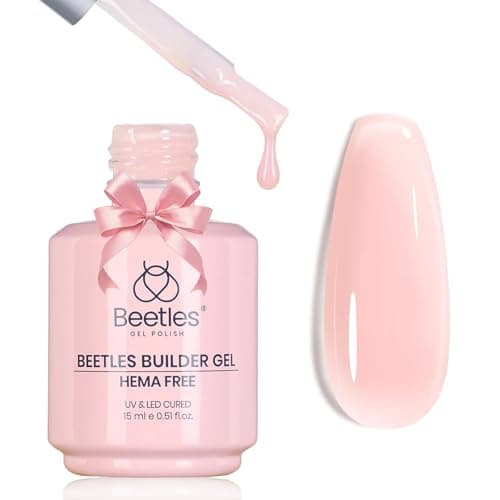
Sensitive skin, and hiding a regrowth line
Beetles Builder Gel, Jelly Pink (HEMA-Free)
A HEMA-free tinted builder — the version to buy if gel has ever made your skin itch or your nails sting under the lamp.
- Bottle
- 15 mL
- Formula
- HEMA-free, sold as 8-in-1
Skip ifSkip this if you want a clear finish. Jelly pink is pink, and it reads as pink over a pale nail.
FAQ
Frequently asked questions
What are the symptoms of a nail glue allergy?
Itching, redness and swelling of the skin around the nail, sometimes with small blisters, typically starting 12 to 72 hours after application rather than immediately. Dry cracked fingertips and reactions on the eyelids or face from touching are also common. A nail lifting from its bed is a more serious sign.
Can you be allergic to nail glue but not gel?
It happens, but the two are chemically related — cyanoacrylate in glue, acrylates and methacrylates in gel — and a sensitivity to one often extends to the family. Patch testing is the only way to know which specific monomers you react to.
What can I use instead of nail glue?
Adhesive tabs are the direct substitute: a pressure-sensitive adhesive rather than cyanoacrylate, published at around five days of wear, and removable without acetone. Pre-applied adhesive sets like KISS imPRESS are the next option, since no liquid ever touches your skin.
Will a nail glue allergy go away?
Contact sensitization does not fade with avoidance the way an irritation does — once your immune system has learned the molecule, exposure tends to provoke a reaction again. The skin heals once the trigger is removed, which is a different thing from the allergy resolving.
Is HEMA-free the same as hypoallergenic?
No. HEMA is the most commonly reported allergen in nail products, so removing it genuinely lowers the risk, but other monomers in the same formula can sensitize too. HEMA-free is a sensible choice, not a guarantee.
Keep reading
Related guides
- Glue vs sticky tabs →
The no-glue route.
- Press-ons that won't damage nails →
Low-exposure options.
- Repairing damaged nails →
Recovery, step by step.
- Gel polish and sensitive skin →
If gel is the trigger.
Sources
- —AAD — Gel manicures: dermatologists share tips · aad.org
- —AAD — Reduce artificial nail damage · aad.org
- —AAD — Healthy nail tips · aad.org
- —Glamnetic — Adhesive Nail Tabs · glamnetic.com
- —KISS — imPRESS no-glue nails · kissusa.com
- —Beetles — Builder Gel for Nails, HEMA-Free Jelly Pink · beetlesgel.com