Guide · Guides
Nail drill bit colors and grit, explained
The color band is a grit rating, and it is standardized. Here is the whole chart and what to do with it.
Written by Janet H. · Owner, Janet Media Group
Published
Tip & Topcoat is reader-supported. Product links go through our affiliate resolver and we may earn a commission from qualifying purchases, at no extra cost to you. Prices belong to the retailer and change constantly, so every button opens the live price on Amazon rather than showing you a number that may already be wrong.
Part of the guides hub.
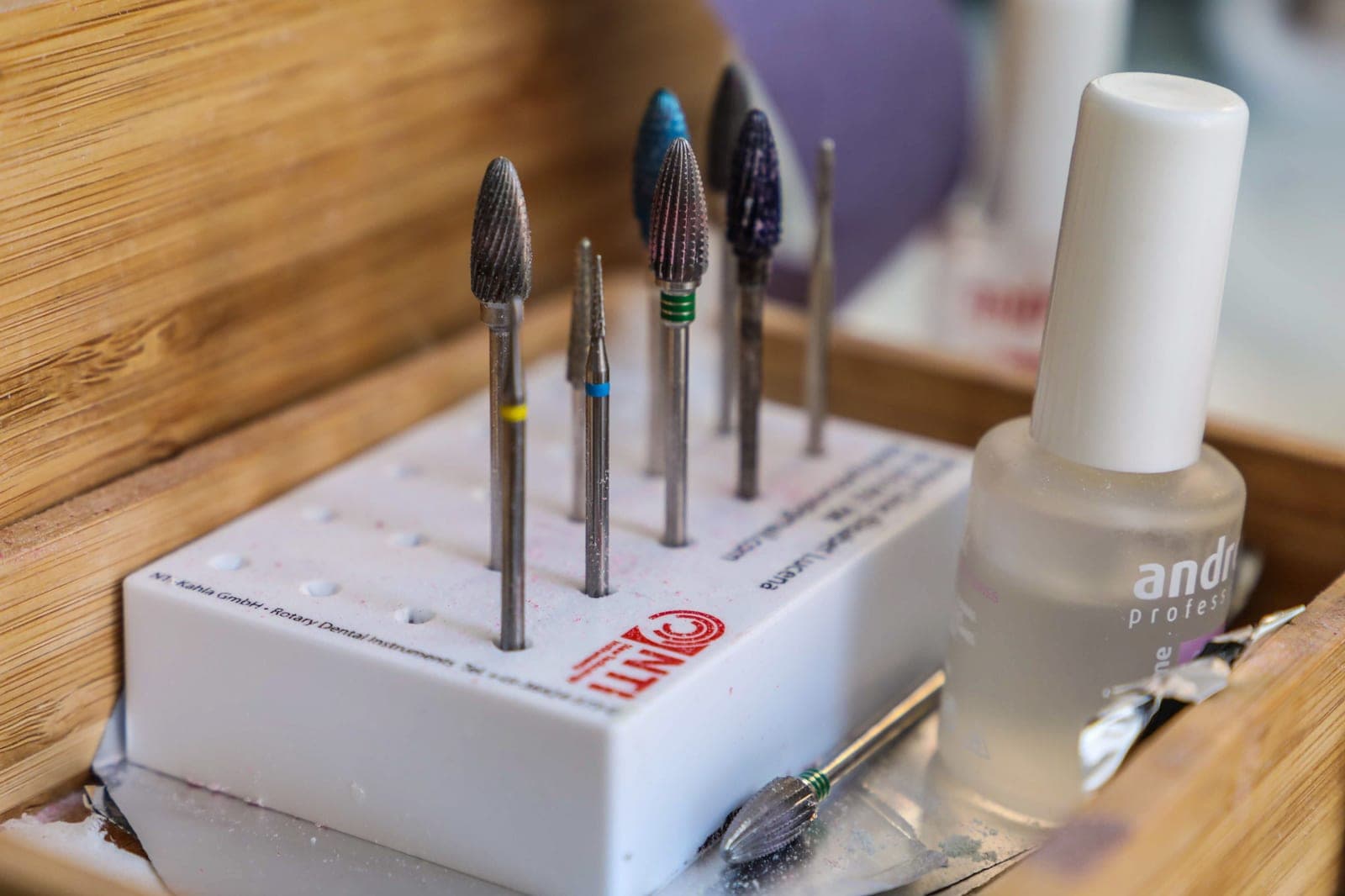
The color-to-grit chart
| Color band | Grit | What it is for | On natural nails? |
|---|---|---|---|
| Yellow | Extra fine | Final smoothing, high shine | Yes, lightly |
| Red | Fine | Cuticle work, gentle prep, finishing | Yes, carefully |
| Blue | Medium | General filing, shaping, gel top layer | With care |
| Green | Coarse | Bulk removal from enhancements | No |
| Black | Extra coarse | Thinning thick acrylic quickly | Never |
The code is used internationally and it is consistent enough to rely on — it exists precisely so that a technician can grab the right bit at a glance rather than reading a label mid-service.
Are nail drill bits universal?
For shank size, effectively yes. Nail drills standardize on a 3/32 inch (2.35 mm) shank, and every drill covered on this site takes it — Medicool states compatibility with any standard 3/32 in bit, and the rest follow the same convention.
That means bits move freely between machines, and you are never locked into one brand's consumables. Other shank sizes exist in industrial and podiatry equipment; if a listing does not state 3/32 in, do not assume it.
Work coarse to fine, and do not skip
The professional sequence is coarse for bulk, then medium, then fine, then extra fine to finish. Each grit removes the scratch pattern left by the one before it.
Skipping steps is the classic beginner error and it backfires twice: the finer bit cannot remove a scratch pattern two grades coarser than itself, and trying to make it do so means more passes, more friction and more heat — the exact conditions that produce rings of fire.
For a home user doing gel removal, the sequence is much shorter: medium to break the top coat seal, then stop and use acetone. You never get to the fine grits because you never go that deep.
Shapes, briefly
Grit tells you how aggressive a bit is; shape tells you where it fits.
- Barrel — the general workhorse. Flat sides for surface work, and the safety-topped version is the one to own.
- Flame — tapers to a point, for the cuticle area and under the free edge. Highest risk, so pair it with the finest grit you can.
- Ball — rounded, for cleaning the sidewalls and cuticle line.
- Cone — for under the free edge and inside the sidewall.
A home user genuinely needs one medium safety barrel. Everything else is optional.
Ceramic, carbide and the safety top
Ceramic runs cooler and resists clogging on gel, which is why it is the right default for home use. It chips if dropped on a hard floor.
Carbide cuts bulk faster and survives abuse. Right for heavy acrylic removal, more than a home user needs.
Safety top is not a material but a shape, and it matters more than either: a smooth, uncut rounded top that skates off skin instead of cutting it. Whatever material you buy, buy the safety version.
Picks
The bits worth owning
A home user needs medium and fine, in ceramic, with a safety top. That is the whole shopping list.
Taking gel and dip off without touching the skin
Makartt Ceramic Safety Nail Drill Bit Set
Ceramic safety bits in the standard 3/32 in shank — the rounded top is what keeps the bit off your cuticle.
- Shank
- 3/32 in (standard)
- Type
- Ceramic, safety (rounded) top
Skip ifSkip this if you are removing thick acrylic every week. Carbide cuts bulk faster and survives more abuse.

A first drill you will not immediately hurt yourself with
MelodySusie SC320G Rechargeable Nail Drill
Cordless, one-button forward/reverse, and a dial that genuinely starts near zero — the combination beginners need.
- Speed
- 0–30,000 RPM, dial
- Power
- 4000 mAh, 8–12 h per charge
Skip ifSkip this if you want a pedal so your free hand can steady the finger. The corded Scarlet has one.
FAQ
Frequently asked questions
What do the colors on nail drill bits mean?
They indicate grit: yellow is extra fine, red fine, blue medium, green coarse and black extra coarse. The code is standardized across the industry.
Are nail drill bits universal?
Shank size is effectively standardized at 3/32 inch for nail drills, so bits interchange between machines. Check a listing states 3/32 in rather than assuming.
What grit nail drill bit should a beginner use?
Medium for general work and gel top coat, fine for anything near the cuticle. Coarse and extra coarse remove material faster than you can judge.
What order should you use nail drill bits in?
Coarse for bulk, then medium, then fine, then extra fine. Skipping a step leaves scratches the finer bit cannot remove, and trying generates heat.
How long do nail drill bits last?
Until they stop cutting cleanly. The warning sign is finding yourself pressing harder, which turns the bit into a heat source instead of a cutter.
Keep reading
Related guides
- The best drill bits →
Which set to actually buy.
- How to use a nail drill →
Technique for each grit.
- Are nail drills safe? →
Why grit choice matters.
- Drills for gel removal →
Medium grit, then stop.
- The best nail drills →
What the bits go in.
Sources
- —Hytoos — nail drill bit color meaning and grit chart (2026) · hytoos.com
- —NAILS Magazine — 5 things you should know about e-files · nailsmag.com
- —Makartt — nail drill bits · makartt.com
- —MelodySusie — SC320G · melodysusie.com