Roundup · Nail Drills
The best nail drill bits
The bit does the cutting, so it decides the damage. Safety bits and the right grit matter more than the machine.
Written by Janet H. · Owner, Janet Media Group
Published
Tip & Topcoat is reader-supported. Product links go through our affiliate resolver and we may earn a commission from qualifying purchases, at no extra cost to you. Prices belong to the retailer and change constantly, so every button opens the live price on Amazon rather than showing you a number that may already be wrong.
Part of the nail drills hub.
The picks, compared
Row 1 is our pick · click any row for the full review
| # | Pick | Best for | Cost basis | Price |
|---|---|---|---|---|
| 01 | 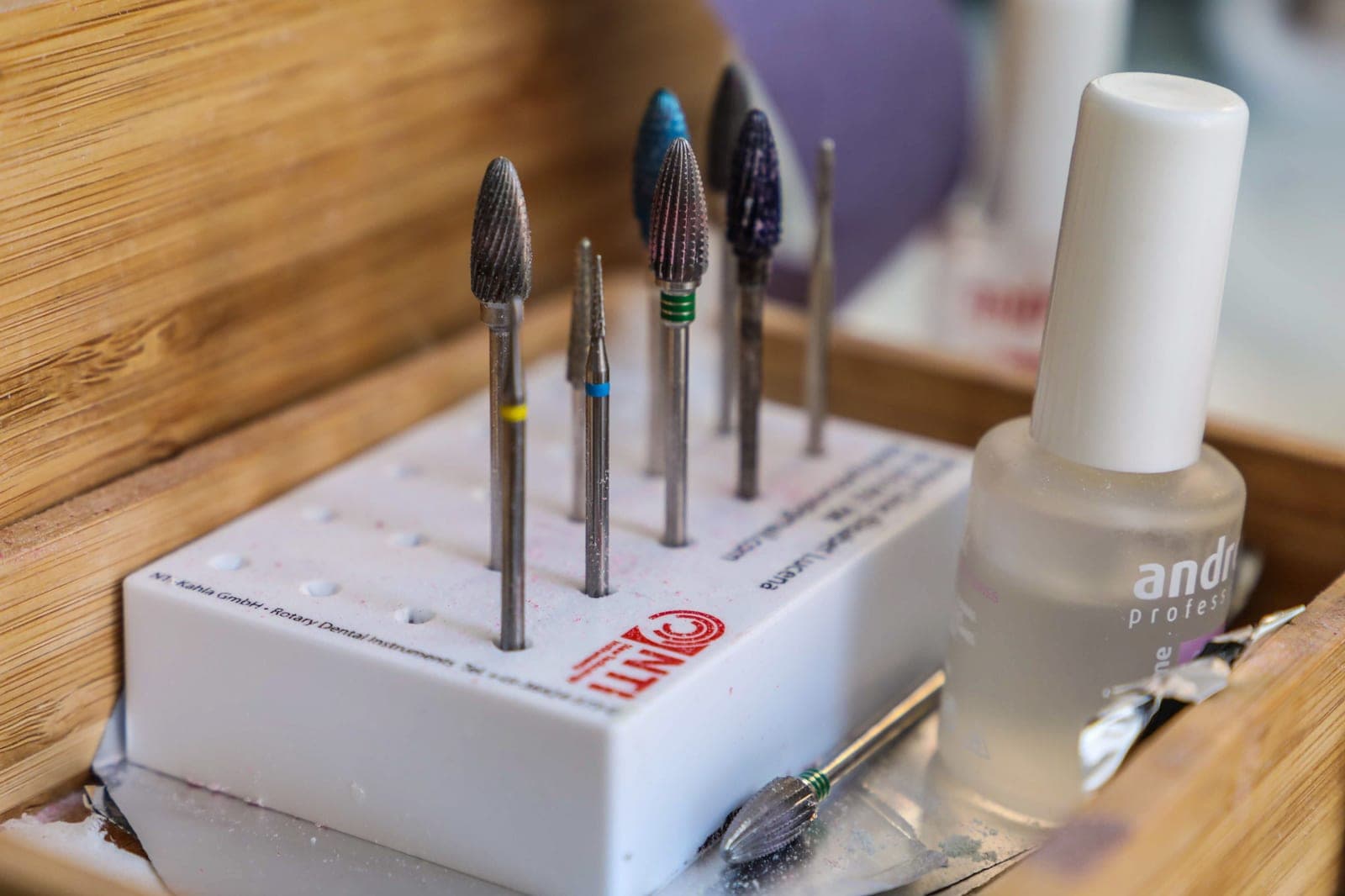 Makartt Ceramic Safety Nail Drill Bit Set Ceramic safety bits in the standard 3/32 in shank — the rounded top is what keeps the bit off your cuticle. 3/32 in (standard) | Taking gel and dip off without touching the skin | Per removal, a set lasts many removals | |
| 02 |  MelodySusie SC320G Rechargeable Nail Drill Cordless, one-button forward/reverse, and a dial that genuinely starts near zero — the combination beginners need. 0–30,000 RPM, dial | A first drill you will not immediately hurt yourself with | One-off, then per removal across years | |
| 03 |  Makartt Genesie Nail Drill Four Japanese precision bearings, which is the specification that actually predicts low vibration and low heat. Adjustable to 35,000 RPM | Long sessions where heat build-up is the real problem | One-off, then per removal across years | |
| 04 | MelodySusie Scarlet SC320I The corded sibling, with a foot pedal — which frees a hand and is why this is the one to learn on. 0–30,000 RPM, variable | Learning technique with both hands free to steady the work | One-off, then per removal across years |
Ranked on a published rubric from each brand's own specs and the pattern of what buyers consistently report. We have not tested these products and do not claim to have.
Buy a safety bit before you buy anything else
A safety bit has a smooth, rounded, uncut top. The sides cut; the top does not. The moment the top contacts skin it skates instead of cutting.
That single design feature removes the most alarming failure mode of a home drill — catching the cuticle or the sidewall — and it costs nothing extra. If you buy one accessory with a drill, buy this. Makartt's ceramic safety bits come in 3/32 in and are rated by the brand for gel polish, extension gel and dip powder.
Ceramic against carbide
| Ceramic | Carbide | |
|---|---|---|
| Heat | Runs cooler | Runs hotter |
| Clogging on gel | Resists clogging | Clogs more |
| Bulk removal speed | Good | Faster |
| Durability | Chips if dropped | Survives abuse |
| Best for | Gel polish, dip, cuticle work | Heavy acrylic removal |
For home use — gel removal, dip, a bit of cuticle tidying — ceramic is the right default. It runs cooler, which matters because heat is the mechanism behind most drill damage, and it does not clog on soft gel the way metal does.
Carbide earns its place if you are removing thick acrylic regularly. It cuts bulk faster and it does not shatter when dropped.
Which grits you actually need
Bits are color-coded to an industry-standard grit scale. The full chart is in the bit color guide, but the short version for home use is:
| Color | Grit | Home use |
|---|---|---|
| Yellow | Extra fine | Final shine on natural nails |
| Red | Fine | Cuticle work, gentle prep |
| Blue | Medium | The workhorse — gel top layer, shaping |
| Green | Coarse | Bulk removal; careful on natural nails |
| Black | Extra coarse | Thick acrylic only |
A home user needs medium and fine, and that is genuinely it. Coarse and extra coarse remove material faster than you can judge, which is the wrong property when the layer you are removing is thinner than a sheet of paper.
Shank size: buy 3/32 inch
The shank is the smooth stem that goes into the handpiece, and 3/32 in (2.35 mm) is the universal size for both home and salon machines. Every drill on this site takes it — Medicool states compatibility with any standard 3/32 in bit.
There are other sizes in industrial and podiatry equipment. For nails, if a listing does not say 3/32 in, do not assume.
Keeping bits usable
Bits blunt, and a blunt bit is a hazard rather than an inconvenience: it stops cutting, so you press harder, and pressure plus friction is exactly what causes heat damage. If you find yourself pressing, replace the bit.
Brush dust off after every use — a clogged bit cuts unevenly and runs hotter. And if anyone else ever uses your drill, bits need proper disinfection between people; they contact nail and sometimes skin, and sharing them unwashed is a genuine infection route.
Every pick in detail
The picks, reviewed
Makartt Ceramic Safety Nail Drill Bit Set
Taking gel and dip off without touching the skinCeramic safety bits in the standard 3/32 in shank — the rounded top is what keeps the bit off your cuticle.
- Shank
- 3/32 in (standard)
- Type
- Ceramic, safety (rounded) top
- Rated for
- Gel polish, extension gel, dip powder
What is good
- A safety bit has a smooth rounded top, so the moment it touches skin it skates instead of cutting — the single most useful feature on a home bit
- Ceramic runs cooler than carbide at the same speed and does not clog the way metal does on gel
- 3/32 in is the universal home and salon shank size, so these fit essentially any drill here
- Sold in sets that span coarse to fine, which is the grit ladder you actually need
What is not
- Ceramic chips if you drop it on a hard floor — carbide survives that, ceramic often does not
- Bit sets vary between listings from the same brand, so check the grits included before buying
Skip this ifSkip this if you are removing thick acrylic every week. Carbide cuts bulk faster and survives more abuse.
Illustrative category photo, not a photo of this product.
- Grit range covered(30%)
- 8
- Safety bit included(25%)
- 10
- Shank fit(20%)
- 10
- Material + lifespan(15%)
- 7
- Value(10%)
- 8
Specs from Makartt — nail drill bits.
MelodySusie SC320G Rechargeable Nail Drill
A first drill you will not immediately hurt yourself withCordless, one-button forward/reverse, and a dial that genuinely starts near zero — the combination beginners need.
- Speed
- 0–30,000 RPM, dial
- Power
- 4000 mAh, 8–12 h per charge
- Controls
- One-button power / forward-reverse / pause
What is good
- A dial that starts at zero rather than at a preset low speed is the single most important beginner feature — you can creep up on the right speed
- Forward/reverse on the same button matters because left-handed and right-handed use need opposite rotation to avoid catching the skin
- Type-C charging with 8–12 hours of stated runtime means it is never tethered to a socket while you work
- No cord dragging across the desk, which is where most wobble comes from
What is not
- A battery is one more thing to fail; a corded machine has no such failure mode
- No foot pedal, so both hands are occupied while you work
Skip this ifSkip this if you want a pedal so your free hand can steady the finger. The corded Scarlet has one.
Illustrative category photo, not a photo of this product.
- Control at low RPM(30%)
- 9
- Heat + vibration(25%)
- 8
- Forward/reverse + handling(20%)
- 10
- Bit compatibility(15%)
- 8
- Value(10%)
- 8
Specs from MelodySusie — SC320G.
Makartt Genesie Nail Drill
Long sessions where heat build-up is the real problemFour Japanese precision bearings, which is the specification that actually predicts low vibration and low heat.
- Speed
- Adjustable to 35,000 RPM
- Bearings
- 4 high-precision, Japanese
- Display
- LCD speed readout
What is good
- Bearing quality is the most honest predictor of heat and vibration in a handpiece, and Makartt publishes it here
- Rated by the brand for natural nails, cuticle work, acrylic, dip powder and poly gel — a genuinely general-purpose machine
- LCD speed display makes a repeatable low-speed setting easy to find again
What is not
- Same problem as the Nouvella: far more top speed than home natural-nail work calls for
- Full-size desktop machine, so it is not a travel drill
Skip this ifSkip this if you want something that lives in a drawer. It is a desktop unit and behaves like one.
Illustrative category photo, not a photo of this product.
- Control at low RPM(30%)
- 8
- Heat + vibration(25%)
- 10
- Forward/reverse + handling(20%)
- 8
- Bit compatibility(15%)
- 9
- Value(10%)
- 7
Specs from Makartt — nail drills.
MelodySusie Scarlet SC320I
Learning technique with both hands free to steady the workThe corded sibling, with a foot pedal — which frees a hand and is why this is the one to learn on.
- Speed
- 0–30,000 RPM, variable
- Power
- Corded, UL-standard adapter
- Extra
- Foot pedal included
What is good
- A foot pedal means you start and stop without taking a hand off the work — the biggest single safety improvement on a home drill
- Corded power means the speed does not sag as a battery drains, which is what causes a bit to grab
- CE certified with a UL-standard adapter, which is more than most budget drills can say
- Low vibration matters more than top speed; a drill that buzzes is a drill you cannot place precisely
What is not
- The cord is genuinely in the way at a small desk
- No cordless option for doing your nails on the sofa
Skip this ifSkip this if your work surface is a coffee table. A pedal and a cord need a proper desk.
Illustrative category photo, not a photo of this product.
- Control at low RPM(30%)
- 9
- Heat + vibration(25%)
- 9
- Forward/reverse + handling(20%)
- 8
- Bit compatibility(15%)
- 8
- Value(10%)
- 9
Specs from MelodySusie — Scarlet SC320I.
How we scored nail drill bits
We do not test these products, and we will not pretend we do. There is no lab here, no stopwatch and no drawer of samples. What we do instead is read every brand's published specification, compare the figures that actually decide an outcome, and weigh them for one specific reader: someone trying to get salon results at home without the salon bill.
So when a wear figure appears on this site it is the brand's claim, attributed to the brand. When a product has no published figure, we say that too rather than filling the gap. The scores below are our editorial judgment applied to those published specs — useful for ranking like against like, and not a measurement of anything. The full method is here.
The weights
- Grit range covered
- 30%
- Safety bit included
- 25%
- Shank fit
- 20%
- Material + lifespan
- 15%
- Value
- 10%
FAQ
Frequently asked questions
What nail drill bits do I need as a beginner?
A medium ceramic safety bit covers almost everything a home user does. Add a fine bit for cuticle work. Coarse and extra coarse are for heavy acrylic and remove material faster than you can judge.
What do the colors on nail drill bits mean?
They indicate grit: yellow is extra fine, red fine, blue medium, green coarse and black extra coarse. Full chart in the grit guide.
Are nail drill bits universal?
Shank size is effectively standardized at 3/32 inch for nail drills, so bits swap between machines. Check the listing says 3/32 in rather than assuming.
Ceramic or carbide nail drill bits?
Ceramic for home use — it runs cooler and does not clog on gel. Carbide if you are removing thick acrylic regularly, because it cuts bulk faster and survives being dropped.
How long do nail drill bits last?
Until they stop cutting cleanly. The warning sign is finding yourself pressing harder, which is when a bit becomes a heat hazard rather than a tool.
Keep reading
Related guides
- The bit grit and color guide →
The full reference chart.
- The best nail drills →
What the bits go in.
- How to use a nail drill →
Bit choice in context.
- Drills for gel removal →
Where medium grit earns its place.
- Are nail drills safe? →
Why safety bits matter.
Sources
- —Makartt — nail drill bits · makartt.com
- —MelodySusie — SC320G · melodysusie.com
- —Makartt — nail drills · makartt.com
- —MelodySusie — Scarlet SC320I · melodysusie.com