Guide · Guides
Are nail drill bits universal?
Mostly yes, because of one measurement. Here is the measurement, the exceptions, and how to swap a bit without jamming the collet.
Written by Janet H. · Owner, Janet Media Group
Published
Tip & Topcoat is reader-supported. Product links go through our affiliate resolver and we may earn a commission from qualifying purchases, at no extra cost to you. Prices come from Amazon's API, carry the date they were read, and change constantly — the button always opens the current price on Amazon.
Part of the guides hub.
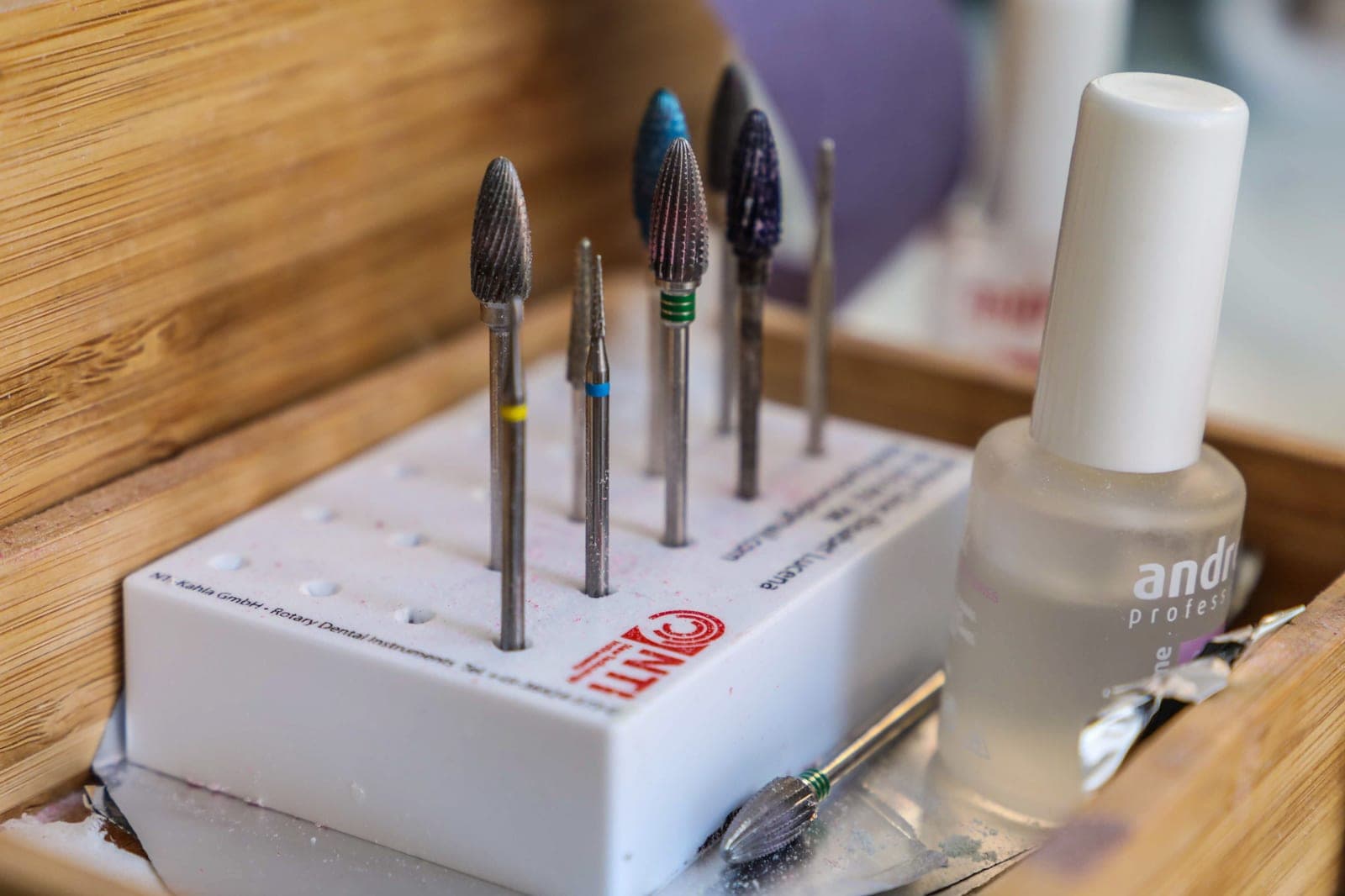
The one measurement that makes bits interchangeable
The part of a drill bit that goes into the machine is the shank, and the only thing that decides whether a bit fits is the shank diameter. Everything else — the head shape, the grit, the material, the color band — is about what the bit does once it is in there.
The industry has settled on 3/32 inch, which is 2.35 mm. It is the size used by essentially every nail drill sold for home or salon use, and it is why a bit set from one brand drops into another brand's handpiece without a thought. Medicool publishes this explicitly for the Pro Power 20K — it takes any standard 3/32 inch bit — and the Makartt ceramic safety set is sold in the same size, which is what makes it fit the MelodySusie and Makartt machines alike.
So the practical answer to the search is: yes, with a check. Read the shank size on the bit listing, read it on the machine listing, and if both say 3/32 inch you are done. If either is silent, assume 3/32 inch for a nail drill and verify before spending much.
The exceptions, and how to spot them
Four things genuinely do not interchange, and all four are visible on a listing if you know what to look for.
| Shank / type | Where you meet it | Fits a standard nail drill? |
|---|---|---|
| 3/32 in (2.35 mm) | Essentially every nail drill | Yes — this is the standard |
| 1/8 in (3.175 mm) | Some podiatry and heavy pedicure handpieces | No |
| 1/16 in (1.6 mm) | Jewelry and craft rotary tools | No |
| Proprietary snap-in pens | A few cordless beauty pens sold as nail drills | No — bits only from that maker |
| Dremel-style collets | Hardware rotary tools | Not without a collet change |
The proprietary cordless pen is the one that catches people out, because it looks like a nail drill and is sold as one. If a listing shows bits that snap or clip in rather than sliding into a collet, and the brand only sells its own bits for it, that is the signal. There is nothing wrong with the tool, but you are locked into one supplier of consumables for its life.
The hardware-store rotary tool is the other recurring question, and the answer is: it is a different machine with a different purpose. Even where a collet can be changed to accept 3/32 inch, the speed range, the vibration and the handpiece weight are all wrong for a nail. Buy a nail drill.
The three collet types, and how each one releases
A collet is the mechanism that clamps the shank. There are three on home machines, and knowing which one you have is the difference between changing a bit in five seconds and jamming it.
- Twist-lock. The most common on modern home drills. You rotate a ring or the front of the handpiece a quarter turn to the unlocked position, pull the bit out, push the new one in, and rotate back. No tools.
- Screw collet. A knurled collar you unscrew a half to one full turn until the bit slides free. Tighten it finger-tight with the bit fully seated — overtightening an empty collet is how they get deformed.
- Push-button or chuck key. Hold the button to lock the spindle and turn the chuck, or use the small key supplied. Less common on consumer machines.
On all three the single most important habit is the same: the machine is off. Not idle, not at zero on the dial — off. A collet that releases while the spindle has any rotation left in it is how a bit ends up across the room.
Changing a bit, step by step
- Switch the machine off at the power switch. If it is cordless, that means off, not paused.
- Let the handpiece cool if you have been working. A hot collet grips tighter, and metal expands.
- Release the collet. Quarter turn for twist-lock, half turn for a screw collet, hold the button for a chuck.
- Pull the old bit straight out. Straight, not at an angle. Wiggling it sideways is what scores a collet.
- Wipe the shank socket. A cotton bud is enough. Dust in the socket means the next bit sits off-center, and an off-center bit vibrates.
- Push the new bit in until it seats fully. The shank should disappear to the shoulder. A bit sitting proud is a bit that will wobble.
- Lock the collet and test at the lowest speed. Any wobble or new noise means it is not seated. Stop and reseat it.
Buying bits when they all fit
Once fit stops being the question, the decision moves to material, head shape and grit — which is where the actual money is wasted in this category. Twenty-piece bit bargains are usually a coarse carbide barrel plus nineteen shapes you will never fit.
The short version. Ceramic runs cooler than carbide at the same speed and does not clog on gel. Carbide cuts bulk faster and survives being dropped, which ceramic often does not. Diamond is for fine finishing and cuticle work. Safety bits — any material, with a smooth rounded top — are the ones to use near skin, because the top skates instead of cutting.
Grit is signaled by a color band, and that system is standardized across brands; a published color-to-grit chart is the fastest way to read a bit you have lost the packaging for. The full chart, and what each grit is actually for, is in the nail drill bit grit guide — that page carries the whole table and this one deliberately does not duplicate it. The ranked picks are in best nail drill bits.
Keeping the fit good over time
Two things degrade the interchangeability you just paid for, and both are avoidable.
A deformed collet. Caused by tightening a screw collet with no bit in it, or by levering a bit out at an angle. A deformed collet grips unevenly, which means every bit you fit afterwards runs slightly off-center and vibrates. There is no repair; it is a handpiece replacement.
Debris in the socket. Filing dust is fine, abrasive and gets everywhere. It packs into the collet mouth, and the next bit seats on top of it rather than in it. Wipe the socket at every bit change — it takes three seconds.
Bits themselves also need cleaning between uses, and not only for hygiene: debris in the flutes makes a bit cut hotter and duller. The trade method for cleaning and disinfecting nail files and bits is the basis for the routine in cleaning and sanitizing drill bits, and how long a bit should last before you replace it is in how long nail drill bits last.
Picks
A standard-shank bit set and a drill that takes it
Both of these are 3/32 inch, which is the whole point of this page: a standard-shank bit set fits essentially any standard-shank machine.
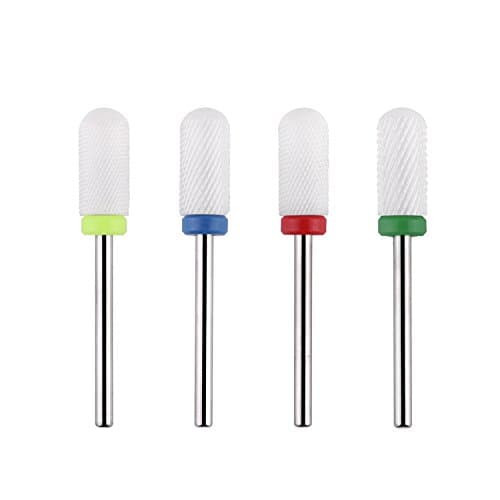
Taking gel and dip off without touching the skin
Makartt Ceramic Safety Nail Drill Bit Set
Ceramic safety bits in the standard 3/32 in shank — the rounded top is what keeps the bit off your cuticle.
- Shank
- 3/32 in (standard)
- Type
- Ceramic, safety (rounded) top
Skip ifSkip this if you are removing thick acrylic every week. Carbide cuts bulk faster and survives more abuse.
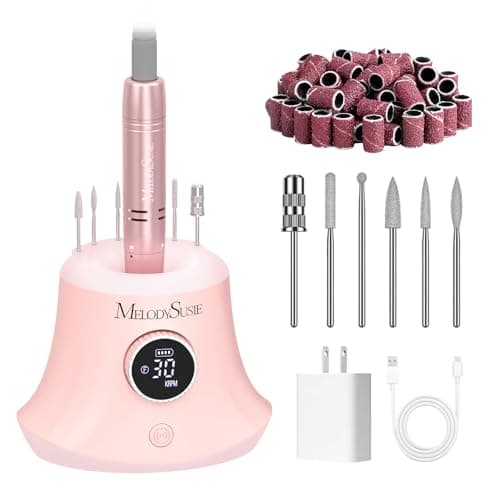
A first drill you will not immediately hurt yourself with
MelodySusie SC320G Rechargeable Nail Drill
Cordless, one-button forward/reverse, and a dial that genuinely starts near zero — the combination beginners need.
- Speed
- 0–30,000 RPM, dial
- Power
- 4000 mAh, 8–12 h per charge
Skip ifSkip this if you want a pedal so your free hand can steady the finger. The corded Scarlet has one.
FAQ
Frequently asked questions
Are nail drill bits universal?
Almost. Nearly every nail drill uses a 3/32 inch (2.35 mm) shank, so bits from different brands interchange freely. The exceptions are 1/8 inch pedicure bits, 1/16 inch craft bits, and a few proprietary cordless pens that only accept their own bits.
Are all nail drill bits the same size?
The shanks are, in the nail category — 3/32 inch is the standard. The heads vary enormously in shape, grit and material, but none of that affects whether a bit physically fits your machine.
Do all nail drill bits fit all drills?
Any 3/32 inch bit fits any 3/32 inch collet, which covers the great majority of machines. Check the shank size on both listings; if a drill only shows snap-in bits from its own brand, it is a proprietary system and nothing else will fit.
How do you change a nail drill bit?
Switch the machine off, let it cool, release the collet — a quarter turn on a twist-lock, a half turn on a screw collet — pull the bit straight out, wipe the socket, push the new bit in until the shank seats fully, then lock and test at the lowest speed.
Can you use a Dremel as a nail drill?
You should not. Even where a collet can be changed to accept 3/32 inch bits, the speed range, vibration and handpiece weight are all wrong for working on a nail, and a nail plate is half a millimeter thick.
Keep reading
Related guides
- Drill bit colors and grit →
The full chart.
- Best drill bits →
Which to actually buy.
- How long bits last →
When to replace one.
- How to use a nail drill →
Technique and speed.
Sources
- —Hytoos — Nail drill bit color and grit chart · hytoos.com
- —NAILS Magazine — 5 things you should know about e-files · nailsmag.com
- —Nail Knowledge — How to clean and disinfect nail files · nailknowledge.org
- —Makartt — nail drill bits · makartt.com
- —MelodySusie — SC320G · melodysusie.com